First Time Home Buyer Tips: 12 Steps From Budget to Closing
This article is for general information only, not financial, tax or investment advice. Rules, rates and fees change, so check the details and talk with a licensed professional about your own situation.
Checked October 30, 2026, against the CFPB, HUD, VA, USDA, Fannie Mae and Freddie Mac websites. This is general information, not financial or legal advice. Programs and limits change, so confirm the details with your lender or a HUD-approved housing counselor.
Buying your first house is the biggest purchase most of us will ever make. These first time home buyer tips walk you through the whole thing in order, from the budget to the keys, with the official minimums for each loan program and the places where a little effort saves real money.
We use one example all the way through: a $300,000 house. Swap in your own numbers.
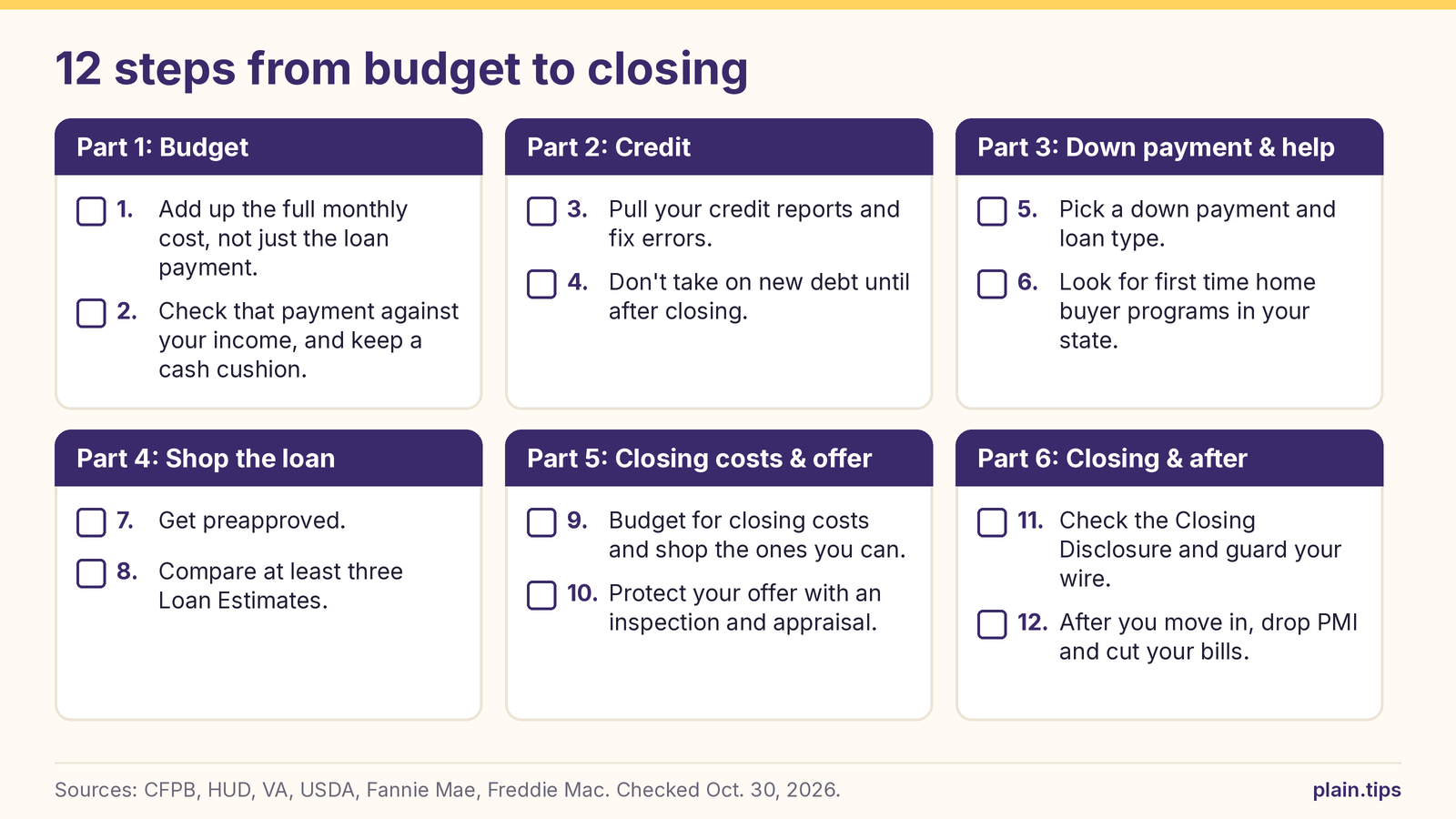
First time home buyer checklist
- Add up the full monthly cost, not just the loan payment.
- Check that payment against your income, and keep a cash cushion.
- Pull your credit reports and fix errors.
- Don’t take on new debt until after closing.
- Pick a down payment and loan type.
- Look for first time home buyer programs in your state.
- Get preapproved.
- Compare at least three Loan Estimates.
- Budget for closing costs and shop the ones you can.
- Protect your offer with an inspection and appraisal.
- Check the Closing Disclosure and guard your wire.
- After you move in, drop PMI and cut your bills.
Part 1: Budget first
1. Add up the full monthly cost
The number a lender quotes you is usually principal and interest. Your real house payment is bigger. The Consumer Financial Protection Bureau’s (CFPB) home loan toolkit tells buyers to add up:
- Principal and interest on the loan.
- Mortgage insurance. A down payment under 20% generally means you’ll pay for it.
- Property taxes. Your county assessor or auditor can help you estimate them. Divide the yearly bill by 12.
- Homeowner’s insurance. Call a few agents for quotes, and ask whether flood insurance is required.
- HOA or condo fees, if the home has them.
Lenders often call the first four “PITI” (principal, interest, taxes, insurance). Many loans collect the taxes and insurance through an escrow account as part of your monthly payment, so they’re easy to forget until the bill arrives in one lump. Get real quotes for the house you want, not guesses.
2. Check the payment against your income, and keep a cushion
The CFPB toolkit gives a rule of thumb: your total monthly home payment should be at or below 28% of your monthly income before taxes. Lenders may approve you for more or less.
Example: a household earning $6,000 a month before taxes would aim for a total house payment of about $1,680 or less (that’s $6,000 × 0.28).
Then do the second step most people skip. Take your take-home pay, subtract the house payment and every other debt (car, student loans, credit cards, child support), and look at what’s left. That money has to cover groceries, utilities, child care, repairs and everything else. If it’s thin, the CFPB suggests a cheaper house or paying down debt first.
Don’t drain your savings for the down payment, either. The CFPB suggests keeping an emergency cushion of at least three to six months of expenses after you close.
Part 2: Get your credit ready
3. Pull your credit reports and fix errors
Your credit affects the interest rate and fees you’re offered. According to the CFPB, about 35% of your credit scores is based on paying on time and about 30% on how much you owe.
- Get your free reports at AnnualCreditReport.com, the official site.
- Look for accounts that aren’t yours, late payments you didn’t make and old balances that were paid off.
- Dispute mistakes with each credit reporting company. The CFPB notes that fixing errors could raise your scores in 30 days or less, so do this before you apply.
- Get current on every bill and stay current. Paying down credit card balances helps too.
The CFPB says some people who improve their credit before buying save $50 or $100 on a typical monthly payment. If you’re close to a better score, it can pay to wait a few months.
4. Don’t take on new debt until after closing
The CFPB warns that even financing a new refrigerator before closing could make it harder to get your mortgage. Hold off on new cars, furniture plans and new credit cards until the house is yours.
If you’re comparing cards for the long run, our guide to the best credit cards for personal use can help, but open the new card after closing, not before.
Part 3: Down payment, loan type and help
5. Pick a down payment and loan type
You don’t need 20% down to buy a house, but less down usually means mortgage insurance and sometimes higher costs. The CFPB says 20% or more likely gets you the best rates and most options, but to “think twice if the down payment drains all your savings.” It also notes that lenders tend to price loans in 5% steps, so putting down “almost” the next step usually saves nothing.
Here are the official minimums for the main loan types, straight from each program:
| Loan type | Minimum down payment | Who it’s for | On $300,000 |
|---|---|---|---|
| Conventional: Fannie Mae HomeReady | 3% | Income at or below 80% of your area’s median; principal residence | $9,000 |
| Conventional: Freddie Mac Home Possible | 3% | Income at or below 80% of your area’s median | $9,000 |
| FHA | 3.5% with a credit score of 580 or higher; 10% with 500 to 579 | Most buyers, including those with lower scores | $10,500 (580+) |
| VA | No down payment, if the price isn’t above the appraised value | Service members and veterans with a VA Certificate of Eligibility | $0 |
| USDA guaranteed loan | No down payment (100% financing) | Income up to 115% of the area median, in an eligible rural area | $0 |
Sources: Fannie Mae, Freddie Mac, HUD, VA.gov and USDA Rural Development, checked Oct. 30, 2026. Lenders can set stricter rules.
A few things the table doesn’t show:
- HomeReady and Home Possible are not just for first-time buyers. Fannie Mae says HomeReady has a 50% debt-to-income maximum, and you may need to take a homeownership education course, such as Fannie Mae’s free HomeView course.
- FHA lets the down payment come from gifts, grants and down payment assistance programs, according to HUD.
- VA loans don’t require monthly mortgage insurance, but most borrowers pay a one-time VA funding fee. You’ll need a Certificate of Eligibility.
- USDA guaranteed loans are 30-year fixed only and must be in an eligible area. Check an address on USDA’s eligibility site.
6. Look for first time home buyer programs in your state
The CFPB says many states and local groups offer programs that help first-time buyers with a down payment or closing costs. Two good places to start:
- Your state housing finance agency. The National Council of State Housing Agencies keeps a list by state.
- A HUD-approved housing counselor. Find one near you, or call the HOPE Hotline at (888) 995-4673, 24/7, as the CFPB suggests.
You may count as a “first-time” buyer even if you’ve owned before. HUD’s rules for its Housing Trust Fund, for example, define a first-time homebuyer as someone who, along with their spouse, hasn’t owned a home during the 3 years before the purchase. That definition also counts single parents and displaced homemakers (24 CFR 93.2). Each program sets its own rules, so ask.
Part 4: Shop for the loan
7. Get preapproved
Get a preapproval letter before you tour seriously. You’ll know your real ceiling.
According to the CFPB, prequalification and preapproval letters both say how much a lender is willing to lend, based on certain assumptions. Neither one is a guaranteed loan offer, and lenders use the two words differently. Some lenders give a “prequalification” based on what you tell them, and a “preapproval” only after they verify your income and assets. The verified kind is worth more.
8. Compare at least three Loan Estimates
Of all the tips for first time home buyers, this one can save the most. The CFPB says to ask at least three lenders for a Loan Estimate, a standard form, so you can compare the same loan line by line. It says buyers can potentially save $600 to $1,200 per year by getting offers from multiple lenders.
- Each lender must send the Loan Estimate within three business days of your application.
- Ask each lender for the same loan type, term and down payment, so it’s a fair comparison.
- Compare the lender’s charges in Sections A and B on page 2. You can shop for Section C services no matter which lender you choose.
- Look at lender credits and points. A point is 1% of the loan, so 1 point on a $270,000 loan is $2,700. Paying points lowers your rate. Taking lender credits lowers your upfront costs but can raise your rate.
Worried about your score? The CFPB says most scoring models let you shop for a mortgage within a window, generally 14 to 45 days, with little or no impact on your scores. Do your rate shopping close together.
Part 5: Closing costs and your offer
9. Budget for closing costs and shop the ones you can
On top of the down payment, you’ll pay closing costs. The CFPB says they typically range from 2% to 5% of the purchase price, not counting the down payment.
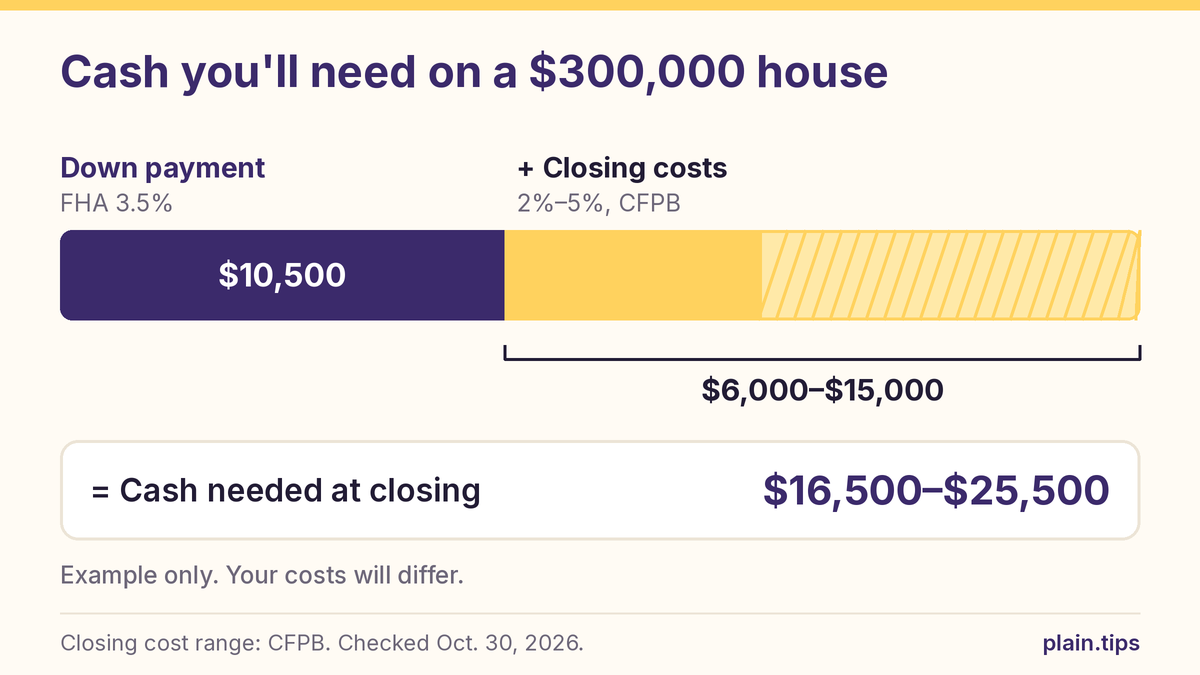
Example on a $300,000 house with 3.5% down:
- Down payment: $10,500
- Closing costs at 2% to 5%: $6,000 to $15,000
- Cash needed at closing: roughly $16,500 to $25,500, before moving costs and your emergency cushion.
What you can do about closing costs:
- Shop for closing services. Your lender gives you a list of companies for things like title and settlement, but the CFPB says you can choose one that isn’t on the list if your lender agrees. The seller can’t require you to use a particular title company.
- Shop homeowner’s insurance. You can get quotes from many companies.
- Ask about lender credits (Step 8), and ask whether any first-time buyer program covers closing costs (Step 6).
- Owner’s title insurance is usually optional. The lender’s policy protects the lender, so ask what an owner’s policy would cover before you skip it.
10. Protect your offer with an inspection and appraisal
Your purchase contract can include contingencies, conditions that let you back out or renegotiate if something goes wrong. Common ones cover the home inspection, the appraisal and your financing. Your real estate agent or attorney will explain what’s standard where you live. Read the deadlines carefully, because a missed deadline can mean losing that protection.
- Inspection: the CFPB says a home inspector works for you and tells you whether you’re buying “a ‘money pit’ of expensive repairs.” Get the inspection before you’re finally committed to buy. Go along, and ask questions.
- Appraisal: the appraiser gives your lender an estimate of the home’s value. The CFPB says you’re entitled to a copy before closing, so you can see how your price compares with recent sales.
Waiving these to win a bidding war can cost you a fortune later.
Part 6: Closing and after
11. Check the Closing Disclosure and guard your wire
Your lender must give you a five-page Closing Disclosure at least three business days before closing, according to the CFPB. Put it side by side with your last Loan Estimate:
- Is the loan amount, rate and monthly payment what you agreed to?
- Did any costs jump? The CFPB says charges for “services you can shop for” generally can’t rise by more than 10% of your final Loan Estimate.
- Is the cash to close what you expected?
Ask about anything that changed before closing day, not at the table. The CFPB’s Closing Disclosure explainer walks through each page.
Watch for wire fraud. Scammers send fake emails that look like they’re from your agent or title company, with new wiring instructions. The CFPB’s advice: pick two trusted people (like your agent and settlement agent), confirm the closing steps with them in person or by phone, and never follow wiring instructions from an email. Call a number you already have to confirm the account name and number before you send a dime.
12. After you move in, drop PMI and cut your bills
Drop PMI as soon as you can. On most conventional loans for a principal residence, the CFPB says:
- You can ask your servicer in writing to cancel PMI when your balance is scheduled to reach 80% of the home’s original value, or sooner if extra payments get you there. You need a good payment history, no second liens, and possibly proof the value hasn’t dropped.
- PMI must end automatically when your balance is scheduled to hit 78%, if you’re current on payments.
- It must also end the month after you reach the midpoint of your loan term.
“Original value” usually means the lower of the sale price or the appraisal. Your PMI disclosure from closing shows the first date you can ask. FHA and VA loans have different rules, so call your servicer.
Then go after the monthly bills. A new house means new utility accounts, and it’s the perfect time to set them up right. Start with our tips to lower your electric bill in winter.
First time home buyer tips: FAQ
How much do you need to buy a house?
It depends on the loan. On a $300,000 house, the minimum down payment is $0 with a VA or USDA loan, $9,000 with a 3% conventional loan or $10,500 with FHA at 3.5%. Add closing costs, which the CFPB says typically run 2% to 5% of the price ($6,000 to $15,000), plus an emergency cushion.
What credit score do I need to buy a house?
For FHA, HUD’s minimum for the 3.5% down payment is a 580 score, and 500 to 579 requires 10% down. USDA’s guaranteed loan program has no set minimum score, but you need to show you can manage debt. Individual lenders can set higher minimums, so ask each one.
Do I have to be a first-time buyer to use these programs?
Not always. Fannie Mae’s HomeReady is open to repeat buyers, and FHA, VA and USDA loans aren’t limited to first-time buyers. State assistance programs often are, but under HUD’s common definition you can count as “first-time” if you and your spouse haven’t owned a home in the past 3 years.
Is preapproval the same as a loan offer?
No. The CFPB says preapproval and prequalification letters are not guaranteed loan offers. Your actual offer is the Loan Estimate, and your final terms are on the Closing Disclosure.
Sources
- CFPB, Your home loan toolkit (August 2026 edition)
- CFPB, Determine your down payment
- CFPB, Request and review multiple Loan Estimates
- CFPB, What is a Closing Disclosure?
- CFPB, When can I remove PMI from my loan?
- CFPB, Prequalification vs. preapproval letters
- CFPB, Programs for first-time home buyers
- CFPB, Mortgage closing scams
- HUD, FHA Single Family Housing Policy Handbook 4000.1 (last revised Aug. 12, 2026; credit score and LTV limits) and FHA Myths vs. Facts
- HUD, 24 CFR 93.2, definition of first-time homebuyer (eCFR, current)
- VA, VA-backed purchase loans
- USDA Rural Development, Single Family Housing Guaranteed Loan Program
- Fannie Mae, HomeReady Mortgage
- Freddie Mac, Home Possible and 2026 AMI limits
An American Dad
Dad, researcher of everyday money and life questions, and the person friends ask before they buy. I write plain.tips so my family, and anyone else, have one place to find answers worth knowing.