Car Donation Tax Deduction: How It Really Works (and the 1098-C Rule)
If the charity sells your car, you usually deduct only what it sold for. Here's how the $500 rule, Form 1098-C and itemizing really work.
This article is for general information only, not financial, tax or investment advice. Rules, rates and fees change, so check the details and talk with a licensed professional about your own situation.
Updated October 2026. Rules checked against IRS publications on Oct. 28, 2026.
Quick answer: If the charity sells your car, you can usually deduct only what it sold for, not the price you looked up in a pricing guide. The charity’s Form 1098-C tells you which rule applies. And you only get a federal deduction for a car if you itemize.
The ads say “donate your car, get a big write-off.” The real tax deduction vehicle donation rules are narrower than that, and they’re spelled out in IRS Publication 4303, A Donor’s Guide to Vehicle Donation. Here’s how they work in plain English, so you know what you’ll actually be able to deduct before you hand over the keys.
This is general information, not tax advice. Check with a tax pro about your own return.
Tax deduction vehicle donation rules: the short version
It all comes down to what the charity does with the car. According to the IRS:
- The charity sells it for more than $500. Your deduction is generally capped at the gross proceeds from the sale. If you think the car is worth $4,300 and it sells at auction for $3,700, you deduct no more than $3,700. (That’s the IRS’s own example.)
- The charity sells it for $500 or less. You can deduct the smaller of $500 or the car’s fair market value on the day you donated it.
- The charity keeps it, fixes it up, or helps someone in need with it. If the charity makes a “significant intervening use” of the car (say, it uses it daily for a year to deliver food), makes a “material improvement” to it, or gives or sells it well below fair market value to a needy person as part of its mission, you can generally deduct the car’s fair market value on the date you donated it.
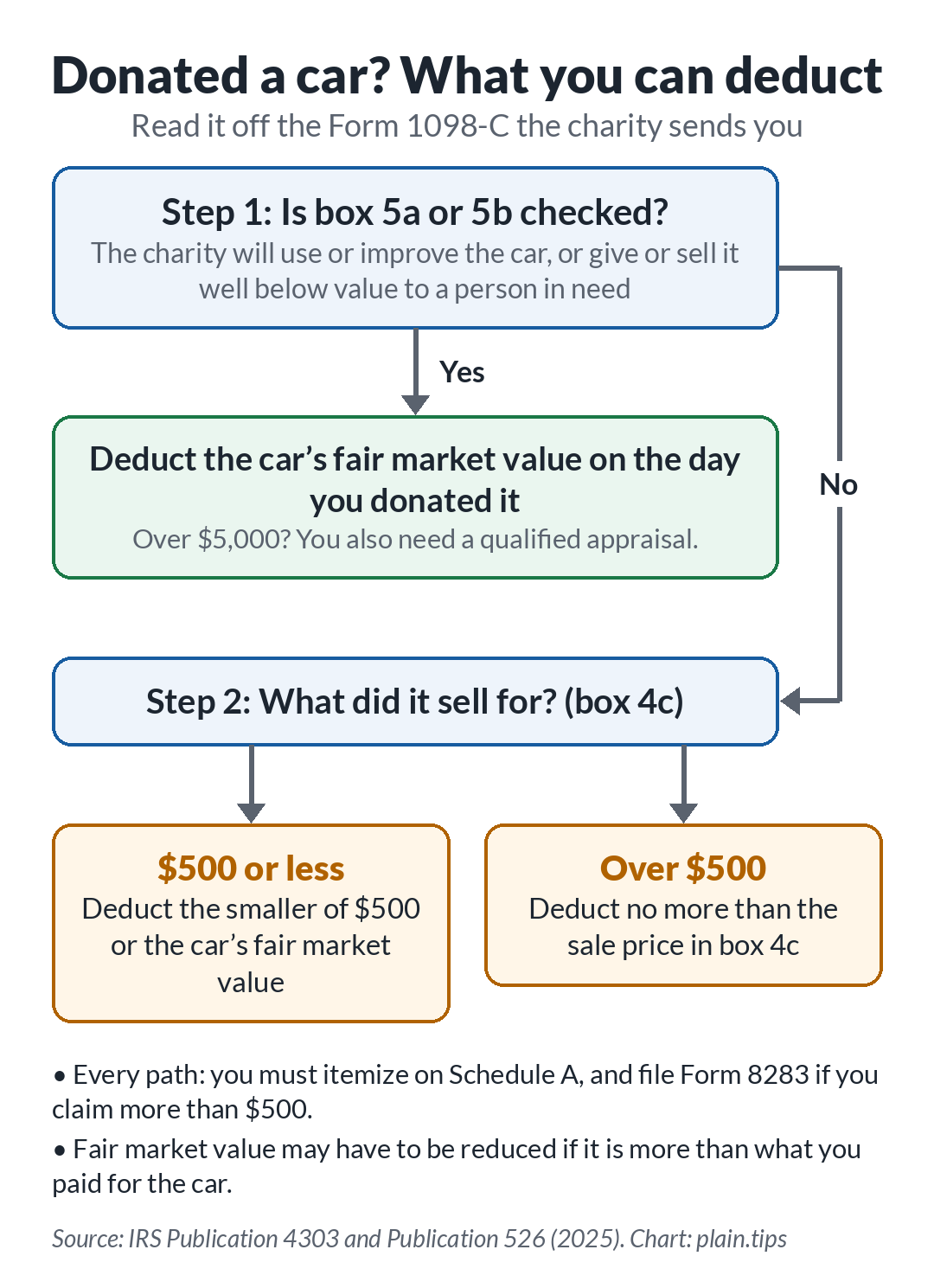
A few details matter. Cleaning, minor repairs and routine maintenance don’t count as a material improvement, and an improvement you paid the charity extra to make doesn’t count either. Use is only “significant” if it’s considerable and actually furthers the charity’s regular work. And the needy-person exception doesn’t apply if the charity simply sells the car at auction and uses the money to help people.
One more catch from Publication 526: if your car’s fair market value is more than what you paid for it, you may have to reduce the amount you deduct. For most used cars that won’t come up, but it can with collector cars.
“Charities typically sell the vehicles that are donated to them. If the charity sells the vehicle, generally your deduction is limited to the gross proceeds from the sale.”
IRS Publication 4303, A Donor’s Guide to Vehicle Donation
You only get the deduction if you itemize
This is the part most car-donation ads leave out. Publication 4303 says it directly: “You can deduct contributions to charity only if you itemize deductions on your Schedule A of Form 1040.”
If you take the standard deduction, donating a car won’t lower your federal tax. Starting with tax year 2026, the IRS says people who don’t itemize can deduct up to $1,000 ($2,000 married filing jointly) of cash gifts to qualified charities. A car isn’t cash, so it doesn’t count toward that.
If you’d rather sell the car yourself and give the money, the cash gift is what counts. Publication 526 counts gifts by check, debit card or credit card as cash contributions. If you give by card, a solid everyday cash-back credit card earns rewards on the gift, and the card statement can serve as your record. (Any single gift of $250 or more also needs a written acknowledgment from the charity.) Your own math (and a tax pro) can tell you which route nets more.
The 1098-C rule: the paperwork that makes or breaks it
If you deduct more than $500, the charity has to give you a written acknowledgment, and most use Form 1098-C, Contributions of Motor Vehicles, Boats, and Airplanes. The timing rules:
- If the charity sells the car: you must get the acknowledgment within 30 days of the sale.
- If one of the exceptions applies: you must get it within 30 days of the donation.
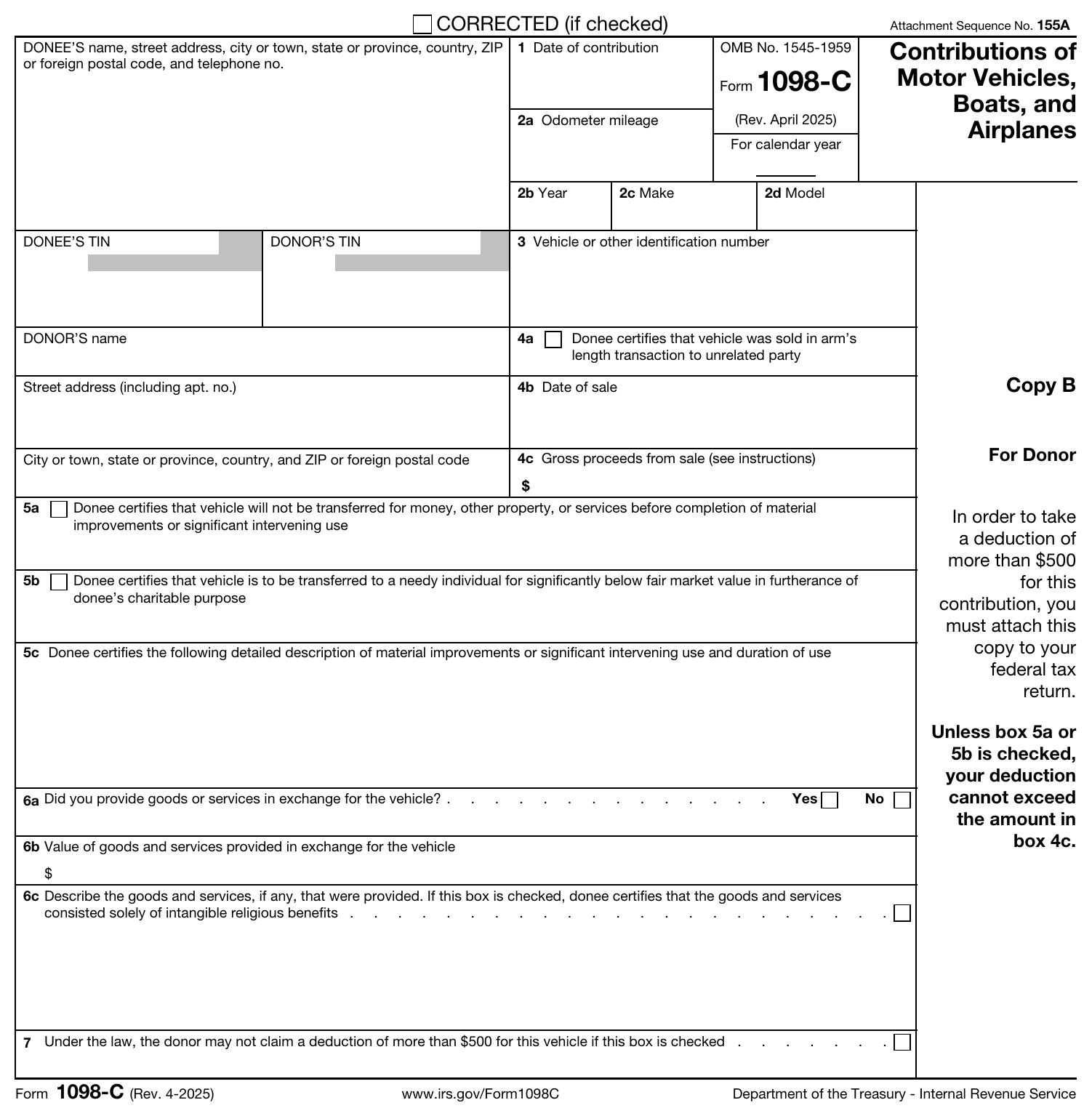
When it arrives, check these boxes:
- Box 3: the vehicle identification number. It should match your title.
- Box 4c: the gross proceeds from the sale. Unless box 5a or 5b is checked, your deduction can’t be more than this amount.
- Box 5a or 5b: checked only if the charity certifies it will use or improve the car, or transfer it to a needy person below fair market value.
- Box 7: if this is checked, you can’t deduct more than $500 for the car.
If the acknowledgment is missing required information, Publication 4303 says the deduction may not exceed $500.
If tax day is coming and you still don’t have a 1098-C, Publication 526 gives two choices: file for the automatic six-month extension (Form 4868), or file on time without the car deduction and amend once the form arrives.
Form 8283 and the bigger-dollar rules
- Deduction over $500 and up to $5,000: fill out Section A of Form 8283 and attach it with Copy B of the 1098-C to your return. If you e-file, Publication 526 says you either mail Copy B with Form 8453 or attach it as a PDF if your software allows.
- Deduction over $5,000: if your deduction is limited to the sale price in box 4c, it still goes in Section A of Form 8283, and no appraisal is needed. If it isn’t limited to the sale price, fill out Section B, which needs a written appraisal from a qualified appraiser and a signature from an authorized official of the charity.
- Deduction of $250 to $500: you need a written acknowledgment from the charity, but you keep it with your records instead of attaching it.
Step by step: donating a car the right way
- Check the charity. Look it up in the IRS Tax Exempt Organization Search. Choose “Pub. 78 Data” and check the deductibility code. Churches and some other groups may not be listed and can still qualify, so ask if you can’t find one.
- Ask what they’ll do with the car. Sell it? Use it? Give it to a family? The answer decides your deduction.
- Figure out the fair market value the right way. The IRS says a pricing-guide value has to match your car’s make, model, year, condition and options, and can’t be more than the private-party sale price. A car that needs major repairs is worth what it would really sell for.
- Handle the title and plates. Publication 4303 says state charity officials recommend the donor take responsibility for transferring the title, which usually means filing a form with your state’s motor vehicle department. Take your plates off unless your state requires otherwise.
- Watch your mailbox for the 1098-C and keep it with your tax papers.
- At tax time, itemize, attach the 1098-C and Form 8283 if you’re over $500, and deduct only what the rules allow.
Bottom line
A donated car can still be a good deal, especially when the charity actually uses it. Just plan on deducting what the 1098-C says, not what the ad promised, and only if you itemize.
Sources
- IRS Publication 4303, A Donor’s Guide to Vehicle Donation
- IRS Publication 526, Charitable Contributions
- IRS Form 1098-C and Instructions for Form 1098-C
- Instructions for Form 8283
- IRS Publication 6196, Charitable Contribution Deduction Tips for Non-Itemizers
- IRS Tax Exempt Organization Search
An American Dad
Dad, researcher of everyday money and life questions, and the person friends ask before they buy. I write plain.tips so my family, and anyone else, have one place to find answers worth knowing.