Tax Deductions for Donations: What Changed for 2026
This article is for general information only, not financial, tax or investment advice. Rules, rates and fees change, so check the details and talk with a licensed professional about your own situation.
Rules checked October 30, 2026, against IRS.gov and the tax code. This is general information, not tax advice. For your own return, check with a tax professional or the IRS.
For years, most families got no federal tax break for giving to church or charity, because they took the standard deduction. That changes with your 2026 return. Tax deductions for donations now reach people who don’t itemize, and itemizers face a new floor. Here’s what applies to you, what counts, and what proof to keep before Dec. 31.
The short answer: tax deductions for donations in 2026
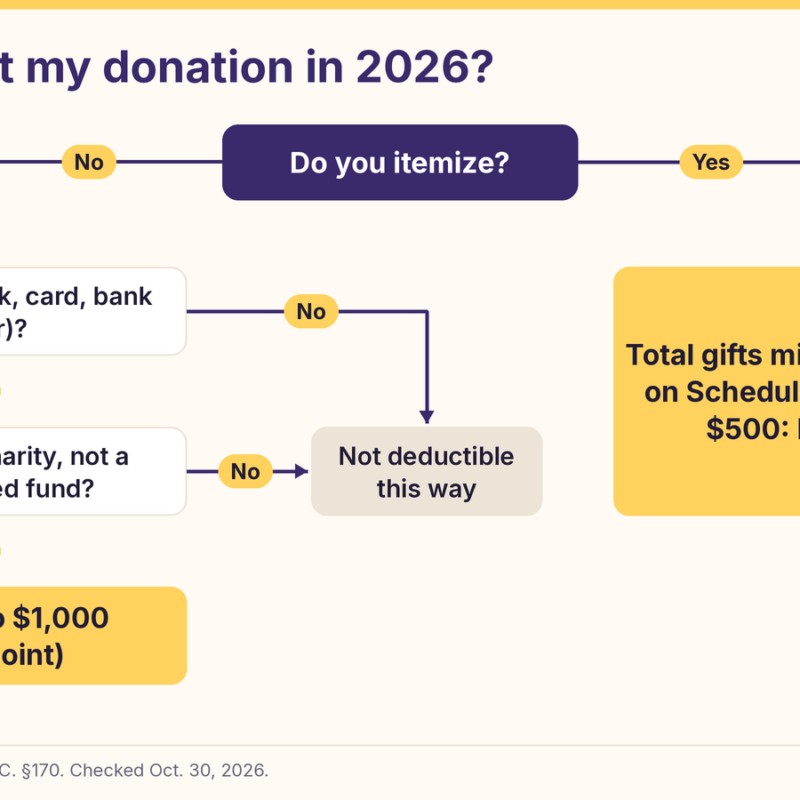
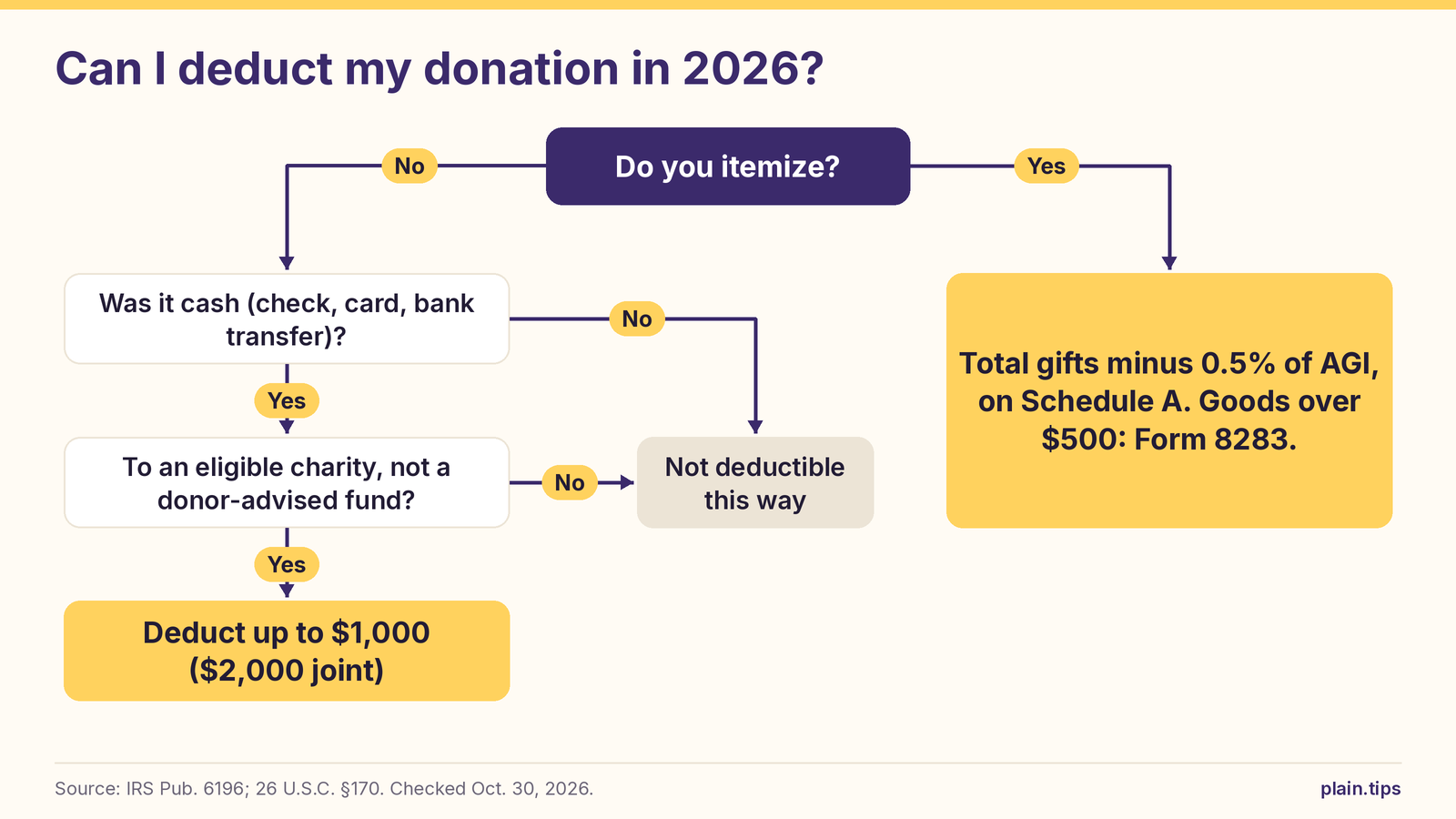
- You take the standard deduction: starting with tax year 2026, you can deduct up to $1,000 of cash gifts to eligible charities, or $2,000 if you’re married filing jointly. Clothing, household goods, stock and gifts to donor-advised funds don’t count toward this deduction. (IRS)
- You itemize: you can still deduct cash and property gifts on Schedule A, but only the part of your total gifts above 0.5% of your adjusted gross income (AGI). (26 U.S.C. §170(b)(1)(I))
- Either way: the gift has to go to a qualified organization, you have to make it during 2026, and you need the right receipt.
New for 2026: deduct donations without itemizing
The One, Big, Beautiful Bill (Public Law 119-21), whose changes the IRS calls the Working Families Tax Cuts, brought back a charitable deduction for people who don’t itemize and made it bigger. It’s permanent and starts with tax year 2026, the return you’ll file in 2027. IRS Publication 6196 lays it out on one page:
- Up to $1,000 of qualifying cash contributions, or $2,000 on a joint return.
- You qualify if you don’t itemize, you made cash contributions during 2026, you gave to an eligible charitable organization, and you kept records, such as receipts or bank records.
What counts as “cash”
The IRS counts more than paper money. Publication 526 says cash contributions include payments by cash, check, electronic funds transfer, online payment service, debit card, credit card, payroll deduction, or a gift card redeemable for cash.
What doesn’t qualify for the non-itemizer deduction
The IRS’s summary of the new law and the code section itself, 26 U.S.C. §170(p), rule out:
- Noncash gifts, such as clothing, furniture, stock or other property.
- Donor-advised funds. A gift that sets up or adds to a donor-advised fund doesn’t count.
- Supporting organizations, the charities described in section 509(a)(3).
- Carryovers. Gifts left over from earlier years don’t count. Only gifts made during the tax year do.
The law limits this deduction to gifts to organizations described in section 170(b)(1)(A), which includes churches, schools, hospitals and most public charities. Your favorite charity can tell you which kind it is, and the IRS search tool (covered below) shows its deductibility code.
Two quick examples (2026, standard deduction):
- You’re single. You give $600 by card to your church and drop $300 of clothes at a thrift store. You can deduct $600. The clothes don’t count toward this deduction.
- You’re married filing jointly. You give $2,500 by check to a food bank. You can deduct $2,000, the cap.
If you itemize: the 0.5% floor and other limits
Itemizing still makes sense if your mortgage interest, state and local taxes, charity and other deductions add up to more than your standard deduction. For 2026, the standard deduction is $16,100 for single filers and $32,200 for married couples filing jointly (IRS).
The new 0.5% floor
Starting in 2026, an itemizer can deduct charitable gifts only to the extent the year’s total is more than 0.5% of your contribution base, which is basically your AGI (26 U.S.C. §170(b)(1)(I)).
Example: your AGI is $120,000. Half a percent is $600. You give $5,000 during 2026. Your deduction is $4,400 ($5,000 minus $600). If you gave only $500, you’d have no charitable deduction on Schedule A.
The floor doesn’t apply to the non-itemizer deduction above. The code says so in section 170(p).
The AGI limits still apply
Most people never get near these, but they’re still there. Publication 526 says your deduction is generally limited to 60% of AGI for cash, and can be limited further to 50%, 30% or 20% depending on what you give and who gets it. The 60% limit for cash gifts to public charities is now written into the code without an end date (26 U.S.C. §170(b)(1)(G)). Publication 526 has a shortcut: if your gifts for the year are 20% of your AGI or less, the extra limits don’t apply to you.
Top-bracket filers
If part of your income is taxed at 37%, a new version of 26 U.S.C. §68 trims your itemized deductions, charitable gifts included, by 2/37 of the smaller of two amounts: your itemized deductions, or your taxable income (counted before those deductions) above where the 37% bracket starts. In practice, each deducted dollar saves you about 35 cents instead of 37. For 2026, the 37% bracket starts above $640,600 for single filers and $768,700 for married couples filing jointly (IRS).
Which rule applies to me?
| Your 2026 situation | What you can deduct | What counts | Watch out for |
|---|---|---|---|
| Standard deduction, single, head of household or married filing separately | Up to $1,000 | Cash gifts made in 2026 to eligible charities | No clothing, goods or stock. No donor-advised funds or supporting organizations |
| Standard deduction, married filing jointly | Up to $2,000 | Same as above | Same as above |
| Itemize on Schedule A | Total gifts minus 0.5% of AGI | Cash and property | AGI limits (60% for cash). Form 8283 for goods over $500 |
| Itemize, with income in the 37% bracket | Same as itemizing, then a 2/37 trim to itemized deductions | Cash and property | Each deducted dollar is worth about 35 cents |
Sources: IRS Publication 6196; 26 U.S.C. §§68, 170(b)(1)(I) and 170(p). Checked October 30, 2026.
Cash vs. goods vs. cars
Cash is the simplest. Keep the record (more on that below), and you’re set.
Clothing and household goods only count if you itemize. Publication 526 says you can’t deduct clothing or household items unless they’re in good used condition or better. You deduct their fair market value, meaning what they’d sell for used, not what you paid. IRS Publication 561 explains how to figure it.
Bigger noncash gifts come with paperwork (IRS Topic 506):
- Noncash deduction over $500: file Form 8283 with your return.
- $500.01 to $5,000 per item or group of similar items: Form 8283, Section A.
- Over $5,000 per item or group of similar items: get a qualified appraisal and fill out Section B.
- Over $500,000: attach the appraisal to your return.
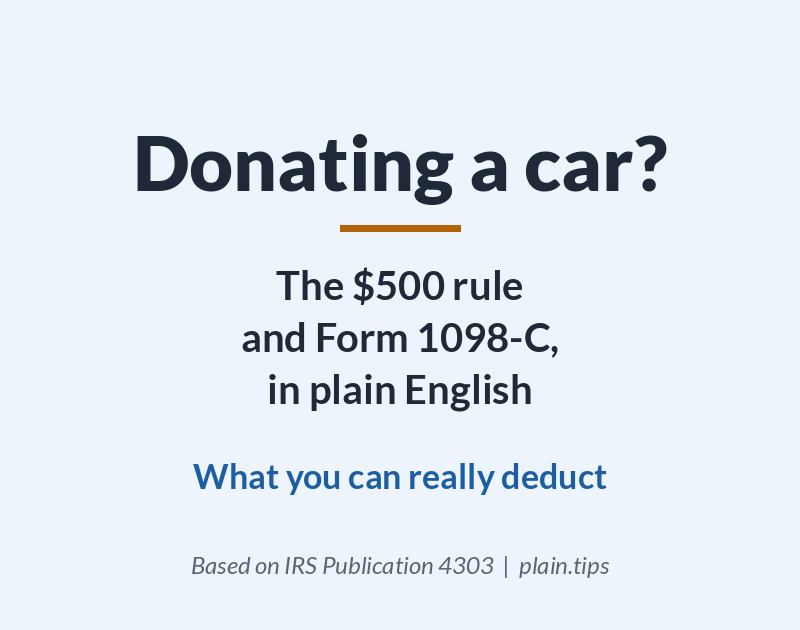
Cars, boats and airplanes have their own rules. Usually the deduction depends on what the charity sells the vehicle for, and it shows up on Form 1098-C. We walked through it step by step in our guide to donating a car.
Receipts and proof: donation receipt requirements
This is where good deductions get lost. Publication 526 and Topic 506 say:
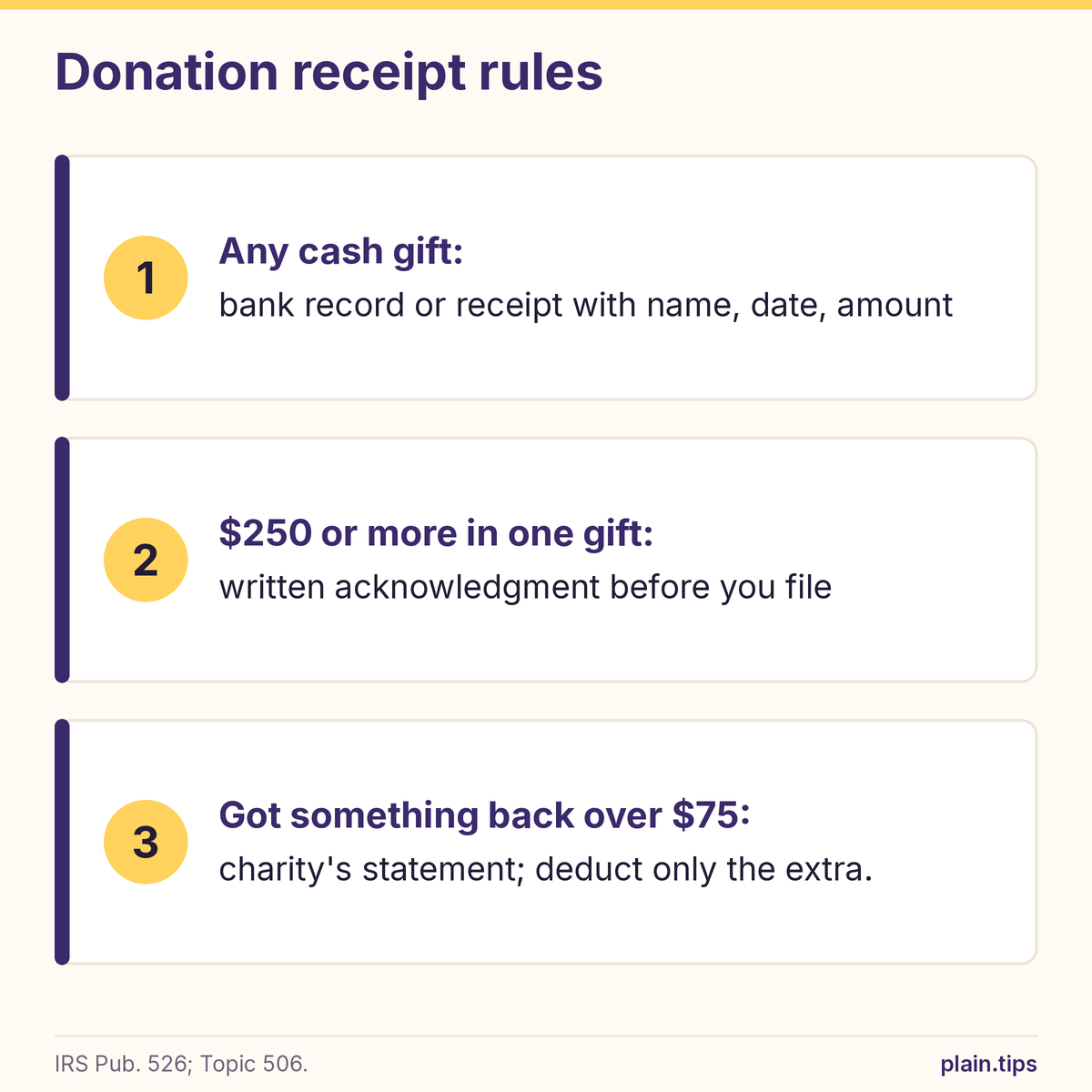
- Any cash gift, even $5: keep a bank record (canceled check, bank or card statement) or a written receipt, letter or email from the charity. It has to show the charity’s name, the date and the amount.
- Any single gift of $250 or more: you need a contemporaneous written acknowledgment from the charity (26 U.S.C. §170(f)(8)). It has to list the amount of cash or a description of the property, and say whether you got anything in return. If you did, it has to describe it and estimate its value. “Contemporaneous” means you have it by the time you file, or by the return’s due date with extensions, whichever comes first. A bank statement alone won’t cover a $250 gift.
- You got something back: if you pay more than $75 and part of it buys goods or services, like a gala dinner, the charity has to give you a written statement. You can deduct only the part above the value of what you received. A $65 dinner ticket with a $25 meal is a $40 contribution in the IRS’s own example.
Some things never count. Publication 526 lists gifts to individual people (even ones in need), gifts to political candidates and organizations, raffle and lottery tickets, and the value of your volunteer time.
Tip: if you give by card, one year-end search of your statements for charity names gives you most of what you need. If you’re picking a card for everyday spending and giving, see our notes on the best credit cards for personal use.
Check the charity first, and mind the calendar
Is it a qualified organization?
Use the IRS Tax Exempt Organization Search. Publication 6196 gives the steps:
- Choose “Pub. 78 Data” from the first drop-down.
- Search by the charity’s name or EIN.
- Click the question mark to read its deductibility code. Codes like 50% (60% for cash contributions), PC, POF or FED are generally eligible.
If a charity doesn’t show up, that doesn’t always mean your gift isn’t deductible. The IRS notes some churches, government bodies and groups under a group exemption may not appear separately.
Year-end timing: when a gift counts
You deduct a gift in the year you actually make it. Publication 526 says:
- Check: it counts on the date you mail it.
- Credit card: it counts in the year the charge is made, even if you pay the bill in January.
- Text-to-give: it counts in the year you send the text, if it’s charged to your phone account.
- Pay-by-phone account: it counts on the date your bank pays it.
- Pledge: a promise isn’t a gift. A promissory note counts only when you make the payments.
For your 2026 return, make the gift by Dec. 31, 2026. Charities often send year-end statements by Jan. 31, but if a statement covers a $250-plus gift, you need it in hand before you file.
Age 70½ or older?
A qualified charitable distribution (QCD) lets you send money straight from a traditional IRA to charity. You have to be at least 70½ when it’s made, and the money has to go from the IRA trustee directly to the charity (Publication 590-B). For 2026, up to $111,000 of QCDs can be left out of your income (IRS Notice 2025-67). You can’t also deduct a QCD that wasn’t counted in your income.
FAQ
Can I deduct donations without itemizing in 2026?
Yes. Starting with tax year 2026, non-itemizers can deduct up to $1,000 of cash gifts to eligible charities, or $2,000 on a joint return (IRS Publication 6196).
How much can I deduct for charitable donations if I itemize?
Your total gifts minus 0.5% of your AGI, up to the AGI limits, which are generally 60% of AGI for cash. Top-bracket filers also get the 2/37 trim under section 68.
Do clothes I give to a thrift store count for the new $1,000 deduction?
No. The non-itemizer deduction is cash only. Clothing and household goods count only if you itemize, and only if they’re in good used condition or better.
Does a gift to my donor-advised fund count?
Not for the non-itemizer deduction. The IRS says gifts to donor-advised funds and supporting organizations don’t qualify. Itemizers should check Publication 526.
What receipt do I need for a $300 donation?
A written acknowledgment from the charity, received by the time you file. It must show the amount and whether you got anything in return. A bank statement alone isn’t enough for a single gift of $250 or more.
Bottom line
If you take the standard deduction, your 2026 cash gifts finally count, up to $1,000 single or $2,000 joint. Give by check, card or bank transfer to a charity that shows up in the IRS search tool, and keep the record. If you itemize, the first 0.5% of your AGI in gifts won’t count, so it’s worth adding up your total before year-end. Either way, Dec. 31 is the deadline for this year’s return.
Sources
- IRS — Publication 6196 (10-2026), Charitable Contribution Deduction Tips for Non-Itemizers
- IRS — Working Families Tax Cuts (deduction for non-itemizers, Section 70424)
- IRS — Topic No. 506, Charitable Contributions
- IRS — Publication 526, Charitable Contributions (2025)
- IRS — Publication 561, Determining the Value of Donated Property
- IRS — About Form 8283, Noncash Charitable Contributions
- IRS — Tax Exempt Organization Search
- IRS — IR-2025-103, Tax inflation adjustments for tax year 2026
- IRS — Notice 2025-67, 2026 retirement plan limits (QCD amount)
- IRS — Publication 590-B, Distributions from IRAs
- 26 U.S.C. §170, Charitable contributions (Cornell LII)
- 26 U.S.C. §68, Limitation on itemized deductions (Cornell LII)
An American Dad
Dad, researcher of everyday money and life questions, and the person friends ask before they buy. I write plain.tips so my family, and anyone else, have one place to find answers worth knowing.