Photo: Photo: Ente75 (CC0), via Wikimedia Commons.
This article is for general information only, not financial, tax or investment advice. Rules, rates and fees change, so check the details and talk with a licensed professional about your own situation.
Sources checked October 23, 2026.
Unplugging one phone charger won’t move a winter electric bill. The big money usually sits in four places: heat, air leaks, water heating and the price you actually pay per kilowatt-hour. Go after those first.
Some links may earn us a commission at no cost to you.
Find the dollars before touching the thermostat
Start with two bills: the most recent one and the same month last year. Next to each, note the kWh used, the number of billing days and anything that changed in between, such as a colder stretch, a new appliance or more people home during the day. Looking only at the dollar total can hide a rate increase or an unusually cold week.
Find four items on each bill:
- kWh used. This is electricity consumed, not dollars owed.
- Billing days. A 34-day bill will often be higher than a 28-day bill even if habits did not change.
- Variable price. Add per-kWh supply and delivery charges that rise when usage rises. Do not include fixed customer charges in your marginal rate.
- Fixed charges and credits. These usually do not disappear when you save a kilowatt-hour.
Here is a scratch-paper test using illustrative numbers, not a claim about anyone’s bill:
| Item | Example | What it tells you |
|---|---|---|
| Previous usage | 1,200 kWh over 30 days | 40 kWh/day |
| Current usage | 1,395 kWh over 31 days | 45 kWh/day |
| Actual daily change | +5 kWh/day | More informative than +195 kWh |
| Example variable rate | $0.18/kWh | Replace with your billed rate |
| Cost of extra 5 kWh/day | $0.90/day | About $27 over 30 days |
That does not prove the furnace caused the increase. It turns a vague worry into a dollar-sized problem. If your utility offers hourly or daily usage charts, line up the high-use days against outside temperature and thermostat settings. If it offers a time-of-use plan, check when electricity costs more; shifting usage only helps when the rate makes it worthwhile.
A 30-minute winter electric-bill audit
Walk the house in this order. The first checks are cheap or free.
Minutes 0–7: Fix the schedule, not just the setting
The Department of Energy says setting the thermostat 7–10 degrees lower for eight hours a day while you are away or asleep can shave as much as 10% per year off heating bills. That is not a promise of 10% off the entire electric bill. Savings depend on climate, equipment and habits (DOE).
A schedule worksheet:
| Period | Current setting | Setting to try | Comfort check |
|---|---|---|---|
| Everyone awake | ____°F | ____°F | Still comfortable? |
| Everyone asleep | ____°F | ____°F | No cold rooms? |
| House empty | ____°F | ____°F | Pipes and pets safe? |
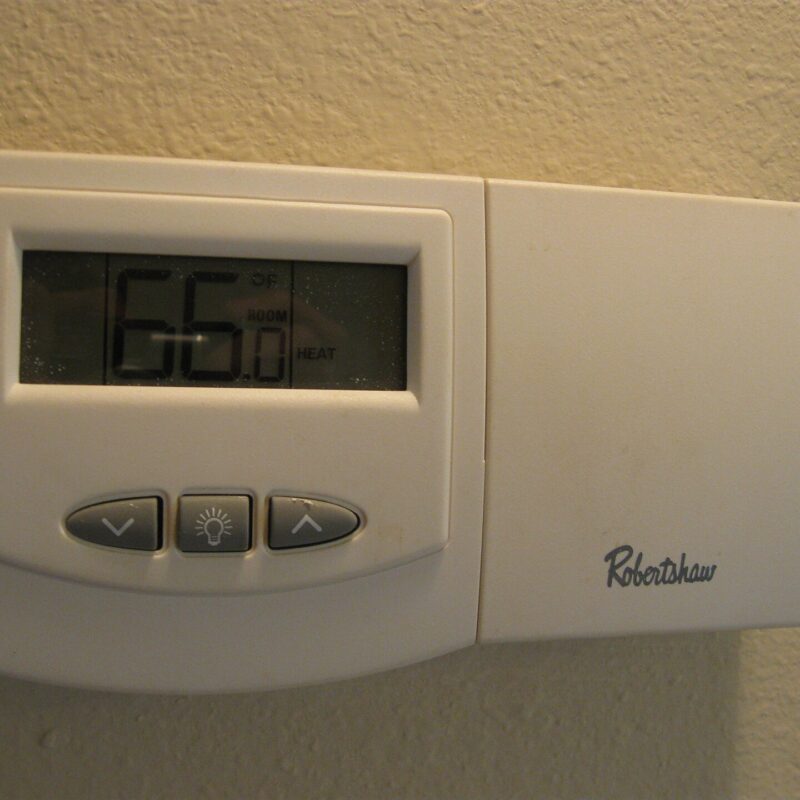
Make one change, then watch the next few days instead of swinging the thermostat around hourly. Heat-pump warning: a large setback can trigger costly auxiliary resistance heat on some systems. DOE’s Building America Solution Center says a programmable thermostat on a heat pump should have adaptive-recovery technology, which is designed to minimize auxiliary heat when the house warms back up. Check your heat pump’s recommended thermostat strategy before following generic advice (Building America Solution Center).
ENERGY STAR says its certified smart thermostats save approximately 8% of heating and cooling bills, or about $50 per year, on average. That is a separate estimate, not savings to add on top of the setback estimate (ENERGY STAR). Try the schedule on the thermostat you already own before buying a new one.
Minutes 7–15: Hunt the leaks
On a cold, windy day, run a hand around exterior doors, window edges and accessible penetrations. A visible gap at the bottom of a door is a cue to install or replace weatherstripping. Caulk gaps that don’t move; weatherstrip parts that do. Never seal required combustion-air openings, flues or ventilation equipment.
EPA’s ENERGY STAR program estimates that homeowners can save an average of 15% on heating and cooling costs by air sealing and adding insulation in attics, floors over crawl spaces and accessible basement rim joists. That is a whole-project estimate; a $10 tube of caulk alone won’t produce 15% (ENERGY STAR methodology).
A priority list:
- Door sweep closes the visible gap.
- Exterior door weatherstripping contacts the frame.
- Accessible window gaps are sealed without trapping moisture.
- Attic hatch closes tightly and is insulated appropriately.
- Open fireplace damper is closed when safe and not in use.
- Suspected duct leakage is photographed for an HVAC professional.
Minutes 15–22: Check filters and registers
Look up the filter size and the replacement interval your system’s manufacturer recommends, then put the next change date on a calendar. Pull the current filter and compare it with that schedule. A dirty filter can restrict airflow, and the Department of Energy’s home energy checklist tells homeowners to clean or replace filters in furnaces, air conditioners and heat pumps.
Also make sure rugs and furniture don’t block supply and return vents. For forced-air systems, ENERGY STAR says about 20 to 30 percent of the air moving through ducts in a typical house can be lost to leaks or poor connections (ENERGY STAR). That’s a reason to investigate damaged ductwork, not a reason to crawl into unsafe spaces or tape over anything labeled as a vent.
Minutes 22–30: Check hot water and hidden electric heat
DOE’s water-heater guidance says to set the temperature at 120°F for most residential applications, and the same page flags Legionella risk under certain conditions (DOE). Read the appliance manual and weigh your own household’s scald and sanitation concerns before adjusting anything. One setting does not suit every home.
Then check the obvious loads: hot-tub heater, basement dehumidifier, electric fireplace, heated floors, garage heater and a dryer running half-empty. A space heater rated at 1,500 watts uses 1.5 kWh per hour at full output. At an example $0.18/kWh, four hours a day costs $1.08/day, or $32.40 in a 30-day month. The rating and time used matter more than the heater’s small size.
Calculate whether a project pays for itself
Run this before buying weatherstripping, a thermostat or an insulation job:
Monthly electricity savings = kWh eliminated × your variable $/kWh.
Simple payback months = upfront cost ÷ estimated monthly savings.
For example, eliminating 100 kWh/month at an illustrative $0.18/kWh saves $18/month, or $216/year, if the same reduction continues all year. A $54 fix then has a simple three-month payback. But heating savings are often seasonal, so a winter-only improvement may take longer. Never count overlapping estimates twice: a thermostat change and attic insulation can both reduce the same heating load.
A simple purchase gate:
| Proposed action | Your cost | Measurable change | Buy now? |
|---|---|---|---|
| Reprogram existing thermostat | $0 | Compare kWh/day | Yes |
| Replace worn door seal | Quote: $____ | Draft disappears; compare bills | If needed |
| Smart thermostat | Quote: $____ | Verify compatibility and rebate | If payback works |
| Professional audit | Quote: $____ | Written findings and priorities | If high usage persists |
| Major HVAC replacement | Quote: $____ | Load calculation, efficiency, bids | Not as a knee-jerk reaction |
Call the utility: ask for these four things
The people who bill you can sometimes point you toward options a home-improvement store cannot. Make one call or use the utility’s signed-in chat, and write down the date, the name of anyone you spoke with, each program mentioned and any reference number. Ask for the rules by email rather than relying on memory.
Call script: “I’m reviewing my electricity costs before winter. Could you tell me my current supply rate, delivery charges and whether I’m on the lowest-cost rate for my usage pattern? Is a free or discounted energy audit available? Do you have rebates for air sealing, insulation or a compatible thermostat? And do I qualify for any bill-assistance or weatherization program? Please email the rules, deadlines and any estimated fees.”
Don’t accept a variable-price supplier pitch without a written comparison. Compare the entire rate structure, contract duration, cancellation charges and whether a promised reduction applies to the total bill or only its supply portion.
For income-qualified households, DOE says its Weatherization Assistance Program is administered at the state and local level, and income is one of the main eligibility factors. Eligibility and the work provided vary by state, so check current terms with your state’s weatherization office rather than an unsolicited contractor.
A two-week proof-of-savings test
- Record daily kWh for seven days with the original settings.
- Change one behavior or repair one obvious leak.
- Record daily kWh for seven more days, noting temperature and household occupancy.
- Compare kWh per day and, ideally, similar-weather days—not just one high or low day.
- Calculate the dollar difference with your actual variable rate, and note that weather can overwhelm a small improvement.
Keep that log with your bills: starting kWh per day, ending kWh per day and the outside temperatures for both weeks. If the bill still spikes, ask the utility about a meter review or a professional audit rather than declaring victory after one mild week.
FAQ
What is the fastest way to lower an electric bill in winter?
For electrically heated homes, check thermostat programming, filters and obvious drafts first. Those checks can be completed without buying equipment. Actual savings depend on the house and heating system.
Does lowering the thermostat one degree save a set percentage?
No universal percentage applies. DOE’s often-cited estimate is for a specific 7–10 degree, eight-hour setback, and it refers to heating bills, not the entire electric bill.
Should I turn my heat off while I’m away?
Frozen plumbing, cold pets or building damage can cost far more than a small saving. Use a safe setback appropriate to local conditions and your heating equipment.
Is a space heater cheaper than central heating?
Sometimes heating a single occupied area can use less electricity than heating an entire house, but electric resistance heat draws substantial power. Calculate watts × hours and consider whole-home safety and temperature needs before deciding.
How can I tell whether my bill rose because of rates or usage?
Compare kWh/day across bills, then compare variable cents/kWh and fixed charges. A higher dollar total with flat kWh usage points toward rates, fees or billing-period differences.
Sources
- U.S. DOE — Six Simple Steps to Save Energy and Money This Winter
- DOE Building America Solution Center — Thermostat Controls
- ENERGY STAR — Smart Thermostat FAQ
- ENERGY STAR — Air Sealing and Insulation Savings Methodology
- U.S. DOE — Home Energy Checklist
- ENERGY STAR — Duct Sealing
- U.S. DOE — Residential Water Heaters
- U.S. DOE — Apply for Weatherization Assistance
An American Dad
Dad, researcher of everyday money and life questions, and the person friends ask before they buy. I write plain.tips so my family, and anyone else, have one place to find answers worth knowing.